
AmCham Kuwait, IOM, CIK, and the IBPC Host Private Sector Dialogue on Workforce Protection and Crisis Preparedness
AmCham Kuwait, IOM, CIK, and the IBPC Host Private Sector Dialogue on Workforce Protection and Crisis Preparedness
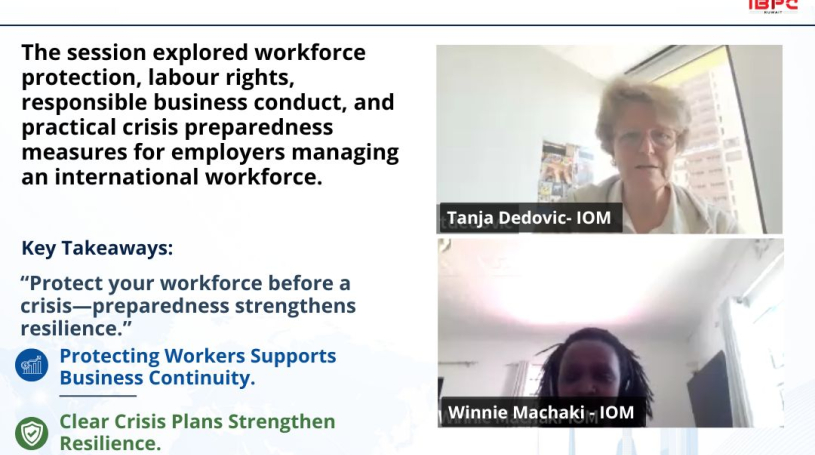
Kuwait City, Kuwait – 9 July 2026 – The American Business Council - Kuwait (ABCK) - AmCham Kuwait, in collaboration with the International Organization for Migration (IOM), Canadians in Kuwait, and the Indian Business & Professional Council (IBPC), hosted the second session of the ‘Human Mobility, Labor Rights & Crisis Considerations’ series. The technical session was delivered by Winnie Machaki, Regional Preparedness and Humanitarian Response Officer, IOM, and Tanja Dedovic, Regional Thematic Specialist on Labor Mobility, IOM, who provided practical guidance on workforce protection, responsible business conduct, labor mobility, and crisis preparedness for employers operating with an international workforce.
The session addressed the growing importance of integrating workforce protection into corporate risk management and business continuity planning, particularly as organizations navigate an increasingly complex global operating environment shaped by geopolitical instability, regional crises, supply chain disruptions, and evolving international expectations on responsible business conduct.
A key message throughout the discussion was the importance of understanding who constitutes a migrant worker. The term does not refer exclusively to blue-collar or low-wage workers. Rather, it encompasses any individual employed outside their country of nationality, regardless of profession, seniority, or sector. This includes executives, healthcare professionals, engineers, academics, consultants, and other highly skilled professionals working under employment visas. While the nature of vulnerabilities may differ across occupations, crises can affect all migrant workers through disruptions to legal status, international mobility, access to services, employment continuity, family reunification, and access to consular assistance. Recognizing this broader definition enables organizations to develop more comprehensive workforce protection strategies that address the needs of their entire international workforce.
Speakers examined the principal risks that migrant workers may encounter throughout the labor migration cycle, including recruitment-related debt, passport retention, wage disruption, contract substitution, restrictions on freedom of movement, discrimination, unsafe accommodation, barriers to justice, and reduced access to essential services. The discussion emphasized that these risks often become significantly more acute during emergencies and can directly impact workforce stability, operational continuity, and organizational resilience.
The session also explored internationally recognized frameworks that increasingly influence corporate governance and supply chain expectations, including the United Nations Guiding Principles on Business and Human Rights and the OECD Human Rights Due Diligence Framework. Participants reviewed the importance of embedding responsible business conduct into corporate policies, identifying and assessing human rights risks across operations and supply chains, implementing mitigation measures, monitoring effectiveness, communicating progress, and providing appropriate remediation where adverse impacts occur.
A significant focus of the session was the Migrants in Countries in Crisis (MICIC) Initiative, which provides practical guidance for employers to strengthen preparedness before, during, and after crises affecting migrant workers.
The session highlighted four priority actions for employers:
- Duty of Care: Employers should prioritize the safety, dignity, health, and fundamental rights of all workers throughout every stage of a crisis, regardless of nationality, occupation, or immigration status.
- Non-Discriminatory Access: Emergency assistance, workplace support, and business continuity measures should be available to all workers without discrimination based on nationality, language, or legal status.
- Effective Communication: Organizations should establish reliable multilingual communication systems to ensure workers receive timely information regarding risks, workplace changes, evacuation procedures, emergency contacts, and available support services.
- Collaborative Coordination: Employers should coordinate closely with government authorities, embassies, international organizations, recruitment agencies, suppliers, and local communities to strengthen crisis preparedness, facilitate worker protection, and support coordinated emergency response efforts.
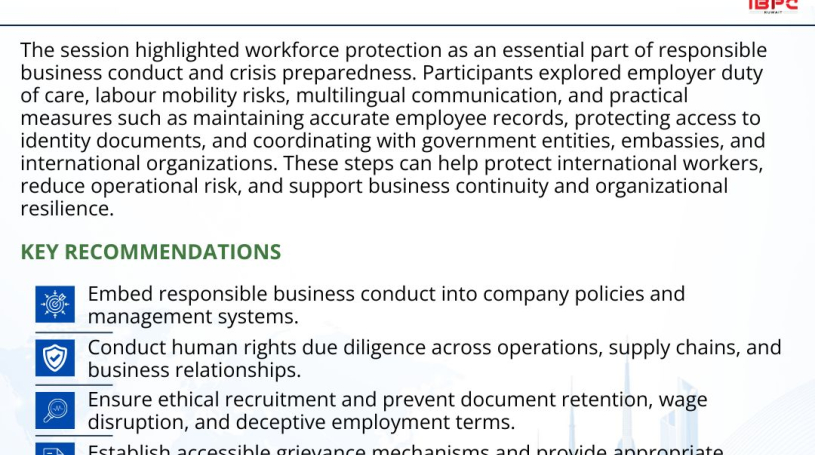
Beyond these guiding principles, participants discussed practical measures that organizations can immediately incorporate into their crisis management and business continuity plans. These include maintaining accurate employee and emergency contact records, reviewing recruitment practices to eliminate exploitative risks, ensuring workers retain possession of their identity documents, establishing accessible grievance mechanisms, developing multilingual emergency communication protocols, and regularly testing response procedures through preparedness exercises.
The discussion further emphasized that workforce protection is not solely a human resources responsibility but a cross-functional governance issue requiring collaboration across leadership, operations, compliance, procurement, legal, and supply chain functions. Effective protection of migrant workers contributes not only to safeguarding human rights but also to reducing operational risk, strengthening organizational resilience, supporting regulatory compliance, and enhancing long-term business sustainability.
ABCK–AmCham Kuwait remains committed to supporting its members by convening expert discussions on emerging regulatory developments, international best practices, and practical business solutions that help organizations strengthen resilience while promoting responsible and sustainable business practices in Kuwait.
About ABCK–AmCham Kuwait
The American Business Council - Kuwait (ABCK) - AmCham Kuwait is the leading voice of American business in Kuwait, dedicated to advancing bilateral trade and investment through advocacy, capacity building, and strategic engagement with the public and private sectors.
About the International Organization for Migration (IOM)
The International Organization for Migration (IOM) is the leading intergovernmental organization working to promote humane and orderly migration while supporting governments, businesses, and communities in addressing migration challenges, protecting migrant workers, and strengthening resilience during crises.