
AmCham Kuwait, in Collaboration with AmCham Qatar and Fenchurch Faris Insurance Brokers, Hosts Webinar on Corporate Insurance and Risk Preparedness
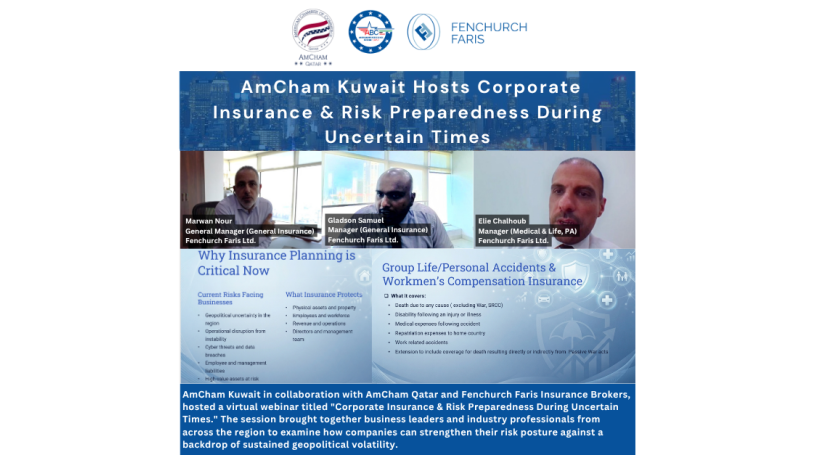
The webinar was moderated by Paola de la Roche, Executive Director of AmCham Kuwait, who opened the session by noting that the current regional environment has made proactive risk planning not just advisable, but operationally critical. She emphasized that cross-regional collaboration between chambers of commerce provides a meaningful platform for businesses to share knowledge and build resilience collectively.
Understanding Corporate Insurance Fundamentals
Gladson Samuel, Manager (General Insurance) at Fenchurch Faris Insurance Brokers, opened the technical segment of the session with a structured overview of key corporate insurance coverage. He guided participants through essential policy categories, including property damage, general liability, workers’ compensation, motor fleet, and marine cargo insurance, contextualizing each within the operational risks currently faced by businesses across the region.
A central theme of his presentation was the importance of regular policy reviews. Samuel cautioned that many businesses operate on coverage that was structured years ago and may no longer reflect their actual risk exposure, asset base, or workforce profile. He encouraged companies to treat insurance program reviews as an active management responsibility rather than a periodic administrative task.
The Geopolitical Coverage Gap
One of the most substantive portions of the session addressed a critical and often overlooked limitation in standard commercial insurance: the near-universal exclusion of war, terrorism, and political violence from conventional policies. Samuel explained that while businesses may believe they are adequately covered, a standard policy will typically not respond to losses directly attributable to armed conflict, civil unrest, or politically motivated incidents.
To close this gap, Samuel detailed the role of Political Violence (PV) insurance as a purpose-built solution for businesses operating in elevated-risk environments. PV coverage can protect physical assets, business interruption losses, and continuity costs arising from events that standard policies explicitly exclude. For companies with operations, supply chains, or significant assets in the region, the discussion made a compelling case that this coverage category warrants serious and immediate consideration.
Sector-Specific Risk and Tailored Solutions
The session addressed how insurance needs vary considerably across industries, and why a one-size approach to corporate coverage falls short. Businesses in manufacturing and construction face distinct property, liability, and equipment risks compared to those in financial services or professional services. Fenchurch Faris presenters encouraged companies to work closely with experienced brokers to develop coverage programs that reflect their specific operational footprint and risk profile rather than relying on generic or off-the-shelf policies.
The Rising Importance of Cyber Insurance
The webinar also addressed cyber insurance as a growing priority, particularly during periods of geopolitical instability. Presenters noted that digital threats, including ransomware, data breaches, and infrastructure disruptions, tend to increase during times of regional conflict as state and non-state actors intensify activity in the cyber domain. Businesses that may not have prioritized cyber coverage were encouraged to reassess that posture given current conditions.
Employee Coverage: Group Life, Personal Accident, and War Risk Extensions
Elie Chalhoub, Manager (Medical & Life, PA) at Fenchurch Faris, who leads the medical and life insurance division, presented on group life and personal accident coverage, topics that drew strong interest from participants. He explained that standard group life policies can be extended to include passive war risk coverage, offering employees protection in the event of injury or death resulting from regional conflict. This extension is not automatic and must be specifically structured within the policy.
The discussion also clarified an important regulatory distinction for Kuwait-based employers: workmen's compensation insurance is a legal requirement, while additional coverage extensions, including war risk and enhanced personal accident benefits, are at the discretion of the employer. Presenters encouraged companies to view these extensions not only as a risk management tool but as a meaningful component of employee duty of care.
Navigating the Claims Process
A dedicated segment of the webinar focused on the claims process, which presenters acknowledged is where many businesses encounter avoidable setbacks. The key steps outlined included timely notification to the insurer upon an incident, prompt engagement of a loss assessor, and meticulous documentation throughout the process.
Presenters identified several recurring issues that lead to claim delays or outright rejections. Underinsurance, where a company's declared asset or liability values fall below actual replacement or exposure levels, was cited as among the most common and consequential problems. Incomplete or poorly organized documentation was flagged as another frequent obstacle, particularly in complex claims involving multiple incident types or jurisdictions. Policy exclusions, especially those related to geopolitical events, were also highlighted as a source of unpleasant surprises for companies that had not closely reviewed the terms of their coverage.
The practical guidance shared in this segment was among the most actionable of the session, giving businesses a clear framework for improving their claims readiness before an incident occurs.
Closing Remarks
Speakers closed the session with a consistent message: in the current environment, waiting for conditions to stabilize before addressing insurance gaps is not a viable strategy. They encouraged companies to initiate an immediate review of their existing coverage, identify gaps in light of current geopolitical realities, and engage qualified brokers to explore specialized solutions where standard policies fall short. Effective risk management, the presenters agreed, is not a contingency measure. It is a foundation of business continuity.
About AmCham Kuwait: Founded in 1985, AmCham Kuwait is a non-profit organization composed of Fortune 500 corporations, SMEs, and prominent business leaders from both the United States and Kuwait. As a key advocate for American business interests in Kuwait, AmCham Kuwait works to strengthen the commercial and economic ties between the two nations. For more information, please visit www.amchamkuwait.org or follow us on social media @abck1985.